January 6, 2026
Why Knowledge Alone Doesn’t Protect: Closing the “Intention–Action Gap” with Serious Gaming
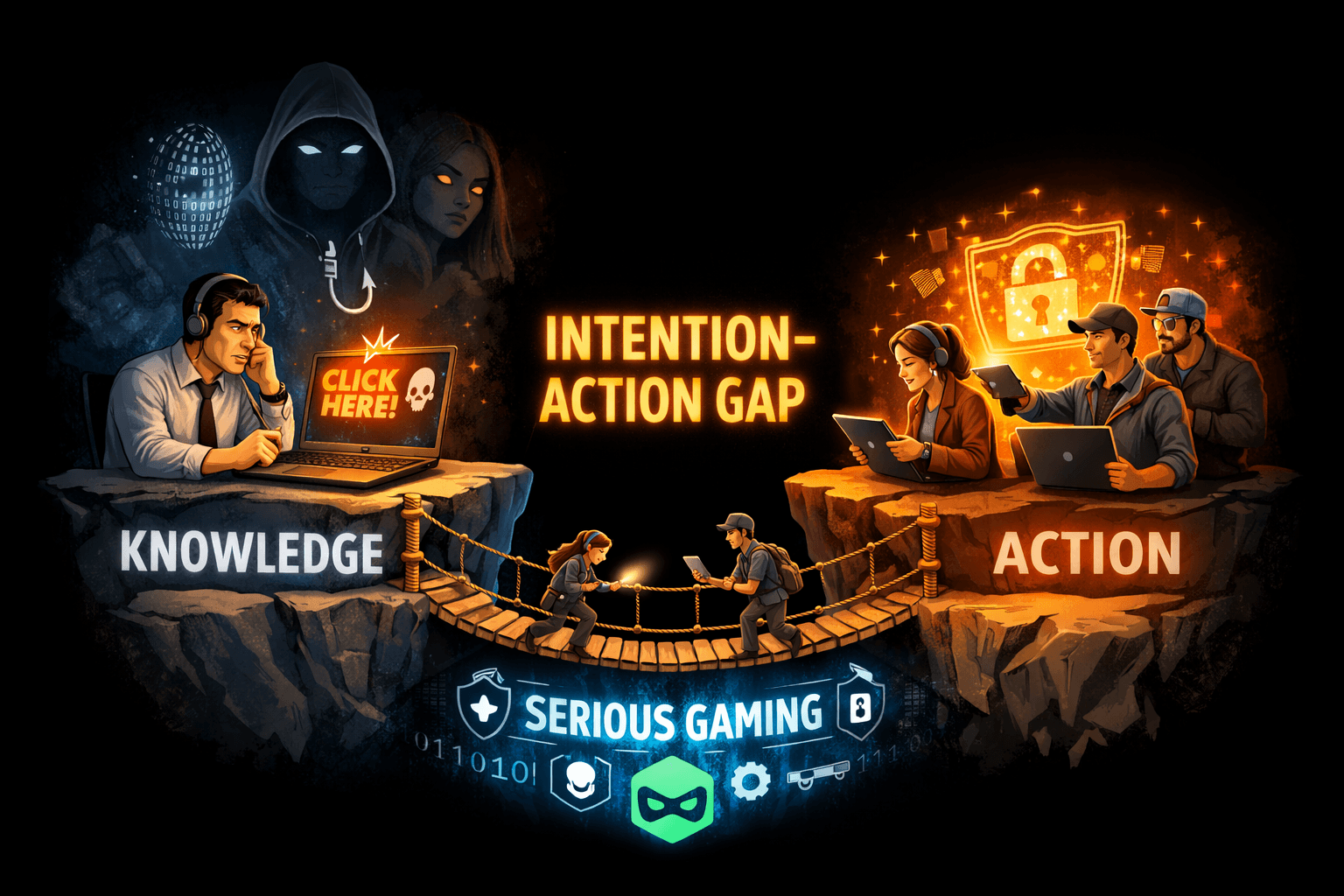
From theory to resilience: How companies, public authorities, and educational institutions can establish a true security culture using the A.C.T.I.O.N. model.
In a world where cyberattacks are becoming increasingly sophisticated through AI-powered pretexting and deepfakes, many organizations still rely on security training based on a “one-size-fits-all” approach. Reality shows, however: knowledge does not equal action. We know we shouldn’t click on unknown links – and yet we still do so under the pressure of everyday work.
In my latest article for the professional journal <kes>, I explain why we can only close this “intention–action gap” through emotional and experience-based learning processes.
The problem: The “human factor” is not a weakness, but an actor
People are often described as the “weakest link” in the chain. But that perspective falls short. Information security is not a purely technical problem that can be solved with a firewall. It is a behavioral challenge. Traditional e-learning formats often fail because they convey information passively. The brain stores this data only temporarily to pass a test, without building the emotional connections that trigger the right behavior in critical situations.
The solution: The A.C.T.I.O.N. model
To achieve real behavioral change, awareness initiatives must meet six psychological and neurobiological criteria. This framework forms the foundation for modern, resilient organizations:
Principle – Practical relevance
Activation: Learning begins with attention. Multisensory stimuli and emotions ensure that learning impulses are anchored in long-term memory.
Choice: Only those who make their own decisions and experience the consequences (including failure!) develop true self-efficacy.
Teaming: Security is a shared responsibility. Social interaction within teams creates collective vigilance.
Iteration: Repetition is key. Serious games allow scenarios to be experienced repeatedly until secure routines are established.
Outcome: Measures must be measurable. Data-driven insights make progress in security culture visible.
Nesting: What is learned must be “nested” into everyday work through small, continuous impulses (micro-learning).
What the Hack!: Bringing theory into practice
It’s one thing to write about these models – it’s another to bring them to life. This is exactly where What the Hack! comes in. Designed as a serious game, it translates the insights of the A.C.T.I.O.N. model into an engaging learning experience.
Companies, public authorities, and educational institutions use What the Hack! to:
Turn fear into competence: Instead of raised fingers, participants experience exciting missions.
Strengthen the social glue: Teams work together to fend off threats.
Encourage sustainable reflection: After the game, insights are transferred directly to the participant’s own workplace.
Conclusion: It’s time for an awareness upgrade
We can no longer afford to treat security as just a “checkbox on a compliance list.” We must empower people to make the right decisions intuitively. Serious gaming is not a gimmick – it is the engine of modern information security that puts people at the center.
Interested in the scientific foundation?
You can find the full article in <kes> magazine here:
https://www.kes-informationssicherheit.de/print/titelthema-security-schulungen-wie-nachhaltiges-training-gelingt/spielend-lernen-fuer-mehr-resilienz-1/
Would you like to experience What the Hack! live?
We support organizations in increasing their resilience in a playful yet highly effective way. Contact us for a non-binding demo session!
📩 Email: info@sbg-gaming.com
🌐 Website: www.sbg-gaming.com